



Picture the start line at a combine. Your kid is down in a stance, the timer is set, and about 5 seconds of running is about to land on a recruiting profile. An athlete can run a hundred sprints at practice and still never do a real 40, from a real stance, with a real timer on it.
You can train for all of it, though. Our approach has three parts, and they overlap. The first is knowing the rules of each test cold, because a false step on the start or a lazy touch at the shuttle line costs tenths you worked months for.
The second is strength and power, which is the engine under every number on the sheet, since whoever pushes harder into the ground runs faster and jumps farther. The third is plain repetition of the tests themselves, enough that the start, the turn and the landing stop needing any thought.
The four tests, quickly
Sports Training in Colorado Springs, CO
| Test | How it goes | What it tells a scout | What we’d work on |
| 40-yard dash | Straight 40, clocked at 10 and 20 along the way | Your start, and your top-end speed | Those first three steps. Strength backs it up |
| Pro shuttle (5-10-5) | Hand down, 5 to the right, 10 back to the left, 5 through | Can you stop and go again without losing ground? | Keeping your hips down on both cuts |
| Broad jump | One jump forward from a standstill. Hold the landing | Leg power, and whether you can control it | The lifts, then a lot of landings |
| Vertical jump | Reach gets measured flat-footed, then you jump to the flags | How much pop you’ve got | Get stronger, then quicker off the floor |
Getting faster in the 40
Most of the 40 is decided early. It’s timed at 10, 20 and 40 yards, and scouts watch how explosively you get out of a static start. Stand up too fast in the first few steps and good top speed won’t win that time back.
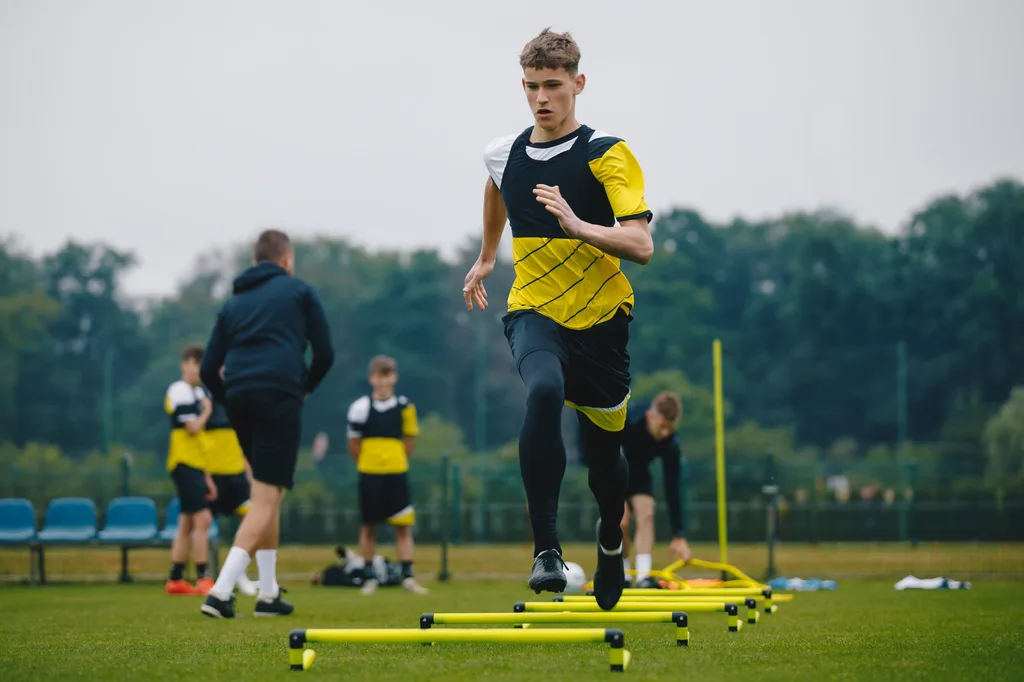
So the start gets its own practice. In our speed and agility work, sprints run from 10 to 40 meters with a focus on acceleration and stride mechanics, and resisted sled runs are loaded to about 10 to 12% of body mass so athletes learn to stay low and push. Flying 30-meter sprints train top speed, and A-skips, B-skips and bounding clean up how the foot hits the ground. Behind all of it is strength. Back squats, front squats and trap bar deadlifts build the leg power that drives the hips forward on every step.
It works. Everett Ellis, a running back who trained in our 1-on-1 and speed and agility programs, reports running a 4.5 40 before moving on to San Diego Mesa College.
How do you train for the pro shuttle?
Here’s how it goes. Hand down in a three-point stance, then 5 yards to one side, touch the line, 10 yards back the other way, touch again, pivot, and 5 more through the finish. That’s two dead stops and two restarts packed into a few seconds, and the athlete who stays lowest through them usually wins.
Time gets lost when athletes stand up before the turn or chop their feet to stop. Practice the drill both directions, decide which hand touches each line, and build lateral footwork, single-leg strength and stable ankles. If you’ve never thought about how your ankles affect a cut, read Why Ankle Stiffness Matters for Sprinting, Jumping, and Athletic Performance. We cover more change-of-direction drills, including the 5-10-5 and the 3-cone L-drill, in Speed & Agility Drills: SAQ Training for Colorado Springs Athletes.
How do you add distance to the broad jump?
You jump as far forward as you can from a standing start, and you have to stick the landing. That last part catches people. The test checks balance as well as explosion, so an athlete who jumps far and then falls back or steps forward gives up distance.
Think of it as two separate problems. The jump itself comes from the same place your 40 does, squats and deadlifts, and on top of that we add box jumps and single-leg bounds. The landing is where athletes get caught. So before anyone does a full broad jump, they spend time stepping off a 12-inch box and holding the landing, plus single-leg hops where they have to stop dead. Once that’s steady, the full jump comes back with one rule. Can’t freeze for a second when you land? The rep doesn’t count.
Adding inches to the vertical
Test it first, the way a combine will. Stand flat-footed, measure your reach, then jump and see which flag you hit. The gap between the two is your number.
That number decides the plan. Say a sophomore jumps 19 inches. For him, more squat and deadlift strength is going to do more than any fancy jump drill, because that’s what we focus on at 20 inches or under. A kid at 23 inches is past that, so between 21 and 25 we shift toward power and how fast force gets put into the floor. Over 25, the work moves to technique and more advanced methods. Most weeks have squats, hex bar deadlifts and RDLs on one side and seated box jumps, pogo hops and cleans on the other. Vertical Jump Training: How Colorado Springs Basketball Players Add Inches has the two-day template we use.
What a training week looks like
Three or four days a week, 60 to 90 minutes a session, is what our speed and agility athletes do. The order inside each session is on purpose. Footwork, jumps and reaction drills go first while legs are fresh. Straight-line sprints and conditioning come at the end, after the explosive stuff has already gotten the athlete’s best effort.
Combine prep means a lot of sprinting and jumping, so build rest days in from the start. Our post on Injury Prevention and Athletic Recovery in Colorado Springs: Staying Healthy and Training Smart covers that side of it.
What should you do the week of the combine?
Cut the volume and keep the intensity. The hard work is done, so the goal is showing up fresh. Run a few short rehearsals, sleep well, and warm up on combine day exactly the way you have in practice.
When we host our Pro Combine with Zybec Sports, the company that runs the NFL Combine, athletes test the 40, the 5-10-5 pro shuttle, the L-drill, the broad jump and the vertical jump. Every athlete gets an official SAT, or Standard Athletic Test, score that can be compared with athletes nationwide and used for recruiting. If you’re thinking about the bigger picture, D1 Athletic Training Guide: Preparing High School Athletes for College is a good next read.
Frequently asked questions
What tests are in a sports combine?
Most include the 40-yard dash, the 5-10-5 pro shuttle, the broad jump and the vertical jump. Some also add the 3-cone L-drill.
How is the vertical jump measured at a combine?
Your standing reach is measured flat-footed, then you jump and touch the highest flag you can. The difference between the two is your vertical.
How many times a week should I train for a combine?
Three to four sessions a week works for most athletes, with lighter volume the week of the test.
What is an SAT score at a combine?
SAT stands for Standard Athletic Test. At our Pro Combine, every athlete gets an official SAT score to compare with athletes nationwide and use for recruiting.
Getting ready for a combine in Colorado Springs? AlphaGainz is a veteran-owned performance gym at 2031 B St. that trains high school, college and adult athletes. Call 719-465-8021, book a FREE Evaluation, see our Speed & Agility and Vertical Development programs, or contact us.